
What It Means to Imagine Turkey
Guest Lecture by Sertaç Sehlikoglu (University College London).
Abstract
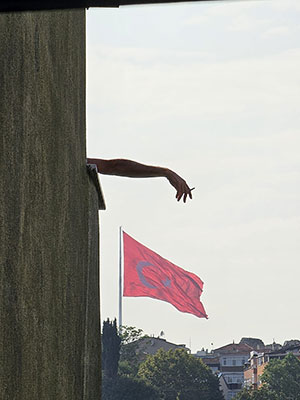 Turkey has long been forging a political imaginary and engineering Turkishness, narrating a particular story of genetic and historical heritage. More recently, it has invested in expansive imaginaries by evoking its imperial past – a phenomenon often termed neo-Ottomanism. Turkey's political, financial, and cultural investments, including the remarkable popularity of its television dramas across the Middle East, parts of Africa, and Southeastern Europe, are frequently analysed through the lens of "soft power." This phenomenon has attracted rising scholarly interest in political imaginaries and populism.
Drawing on multi-sited ethnographic and archival research into the complicated processes through which political imaginaries are forged, this lecture examines what it means to study imagination in the context of Turkey. How are new imaginaries crafted as political currency? How are Turkey's own local struggles translated into exportable narratives? And how are these narratives received, circulated, defended, and dismissed by diverse publics? Rather than relying on International Relations frameworks and concepts like soft power, the lecture experiments with an alternative and more anthropological approach – one that takes the productive entanglement of reality and imagination, and traces how imaginaries move between intimate selfhood and geopolitical reach.
Bio
Sertaç Sehlikoglu is an anthropologist and an Associate Professor at University College London, Institute for Global Prosperity. Her research explores intangible aspects of human subjectivity – such as intimacy, desire, agency, and political imaginaries – that drive social transformation. She has conducted ethnographic fieldwork across Turkey, Lebanon, and the Balkans. Sehlikoglu has led the ERC-funded “Imaginative Landscapes of Islamist Politics” (TAKHAYYUL) project (2020-2025) and authored Working Out Desire: Women, Sport and Self-Making in Istanbul (2021). She has co-edited multiple special journal issues on intimacy, critique, and ethical imagination, and serves as Reviews Section Editor for the Journal of Middle East Women’s Studies and Associate Editor of Contemporary Islam.
Map of South Campus
View directions.
View on map of the Faculty of Humanities - South Campus.
View map of South Campus (pdf).